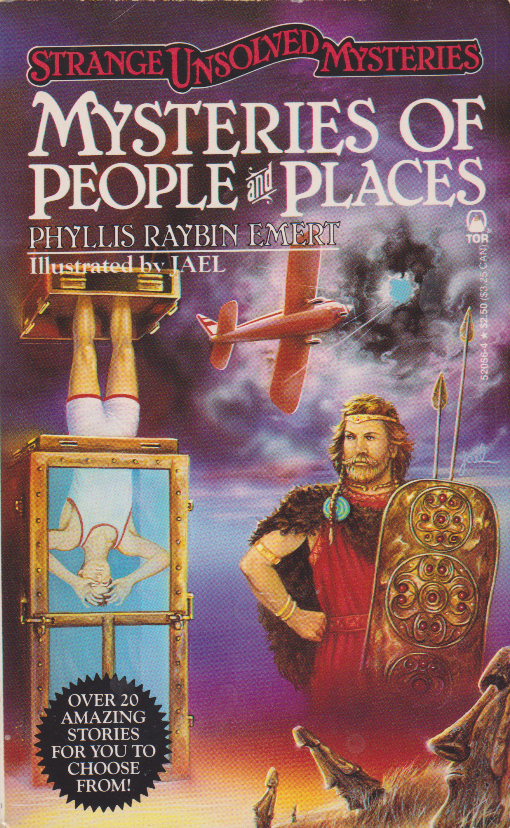
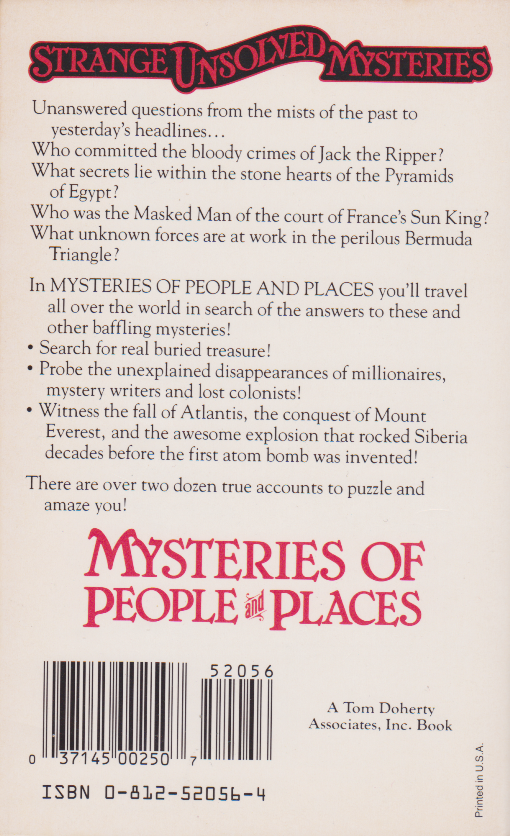
Mysteries of People and Places by Phyllis Raybin Emert
Not only have I been neglecting Forgotten Female Fantasy for months, but also I’m back with something that only counts as “sci-fi” or “fantasy” on the barest of technicalities. Realistically, Mysteries of People and Places is more akin to reading through the show listings for the History Channel during an Ancient Aliens marathon than it is to reading speculative fiction.
So why did I read it?
In part because I’ve been wanting to work this meme into an article for years.

If you don’t get it, go forth and watch Babylon 5 post-haste
Perhaps the most honest answer, though, is that I was run down and it was easy. Each chapter maxes out around 7 pages and no matter how tired or not into-it I was, the middle-grade reading level was effortless to consume. And as my life spiraled around me with unwanted stress and intensity, I knew that Mysteries of People and Places wouldn’t surprise me with a story arc that would only weigh me down further.
A secondary answer is that, like most kids, I devoured shit like this, and just seeing the cover filled me with gleeful nostalgia. Frankly, I assumed that was going to be the highlight of my experience, yet I enjoyed reading this far more than I expected. Maybe it’s my anthropology degree (which has been of no use to me until this very second), but it was so easy to see these stories as modern mythology. While perhaps less wonder-filled than literally thinking that the Bermuda Triangle had some sort of dimensional wormhole within it, it was still interesting to note similarities of themes and structure, and muse on how and why people interpreted something a certain way, and how that interpretation grew and took on a life of its own.
Reading these larger-than-life stories with the help of Wikipedia as an easy reference also changed how I consumed the information. I would normally read the chapter, which took all of five minutes, then spend an hour on Wikipedia fact-checking and broadening my understanding of the phenomena.
Many of the chapters are what you’d expect: The Great Pyramids, The Bermuda Triangle, Harry Houdini.
There were some interesting things in the book that had a little more … weight. Take, for example, the Oak Island money pit. For centuries folks have tried to excavate what they think is buried pirate treasure, yet it almost seems as if elaborate engineering has made it impossible. There’s also the Tunguska Event, in Siberia, where an explosion like multiple atomic bombs completely leveled a huge forest, though no crater was ever discovered.
The former might be nothing more than wishful thinking, and the latter a close-call with a meteor, but it’s still fun to learn about something that isn’t 100% knowable—especially in this modern world where answers are so readily at our fingertips.
It’s hard to punish this book for being what it so obviously meant to be: an over-the-top piece of sensationalist nonsense to try to spur imagination in young folks. So even though there’s a lot to pick at on that front, I’ll move on.
My biggest complaint about the book is that too many of the stories are “So-and-so left … and was never heard from or seen again…”
The fact that the vast majority of these stories are about women is all the more depressing.
Sure, it’s possible some of these women took a look at their lives and said “fuck it, I want to live differently and authentically and ghosting on my current life is the only way to make that happen,” but let’s be honest. A young woman goes out at night, doesn’t have with her anything that makes it seem like she’s leaving for good, and is never seen again?
I think we know the sad end of most of them meet. It’s not some great mystery. It’s a very depressing reality.
Mysteries of People and Places is, obviously, not the sort of book I could or would recommend. That said, I did enjoy reading it, both as a nod to my younger self and as a chance as an adult to parse and chew on the sort of things that filled my younger self with wonder. I feared that it would make me feel foolish for ever finding such topics fascinating, or that it wouldn’t allow me to look back on those feelings of wonder with any sort of understanding, but I was wrong. Even if most of these stories are nothing more than modern mythology, the amount of human investment in them has made them larger-than-life.
I say this, though, as someone without cable television who has only ever experienced the nonsense of the History Channel in passing and in satire. I suspect that if, say, I lived with an older parent who mainlined Ancient Aliens, Mysteries of People and Places would be infinitely less interesting or amusing.
Still, it helped get me back to reading when the thought of picking up a novel was far too much, so I’m happy it was on my shelf.